History repeats itself.
Chapter X ended in 1893, with the miners of the Coeur d'Alenes out of the bullpen and building a federation of their own. The story does not end there, and the way it does end is a warning to us.
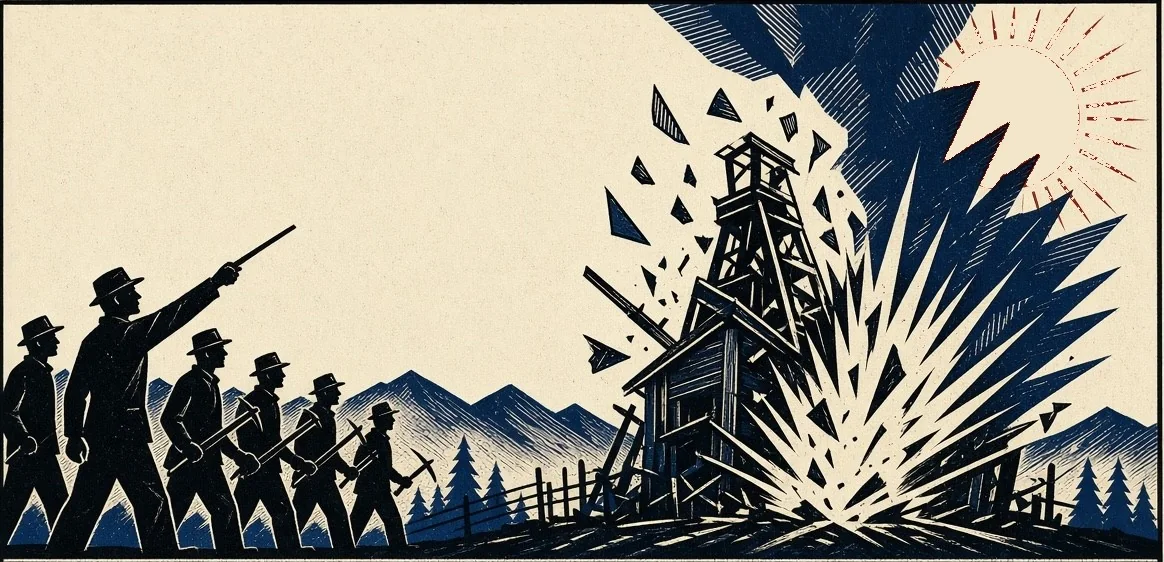


The men who had been in that bullpen were Irish, Italian and Slavic, and a great many of them, like the men who led their unions, were Catholic. Their unions were built in the parish as much as in the union hall, and they were not asking for a revolution. They asked for a living wage, a shorter day, a mine that did not kill them, and the right to be treated like men. They cared about money too. The silver they dug had been money until Congress demonetized it in 1873, and they wanted a dollar that could not be managed from a bank in New York. Idaho's silver counties went for Free Silver and sent Populists to Boise while the eastern money called them cranks.1 Faith, Family and Freedom were what those men had, long before anybody made a slogan out of the words, and the Mine Owners' Association was taking all three away from them.
What happened to them has happened to rooted people ever since, and it came in three parts. The first was a label. In Pennsylvania in the 1870s, the railroad and coal baron Franklin Gowen had hired the Pinkertons to send an informant named James McParland into the Irish Catholic mining towns of the anthracite country. McParland came back with a conspiracy called the Molly Maguires, and on his testimony, with Gowen himself acting as prosecutor, twenty Irishmen were hanged between 1877 and 1879. Historians still argue about how much of the Mollies existed outside McParland's notebook. The hangings did their work either way, because after them any Irish Catholic who asked for better pay could be called a Molly.2
The second was another label, “anarchist,” and this one could be used on anybody. The cities of the 1880s had real anarchists. The Haymarket bomb in Chicago in 1886 killed seven policemen, and it handed every employer in America a word to use against any workingman who organized.3 The Coeur d'Alene miners were not anarchists, but the Pinkertons called them that anyway, because the word worked.
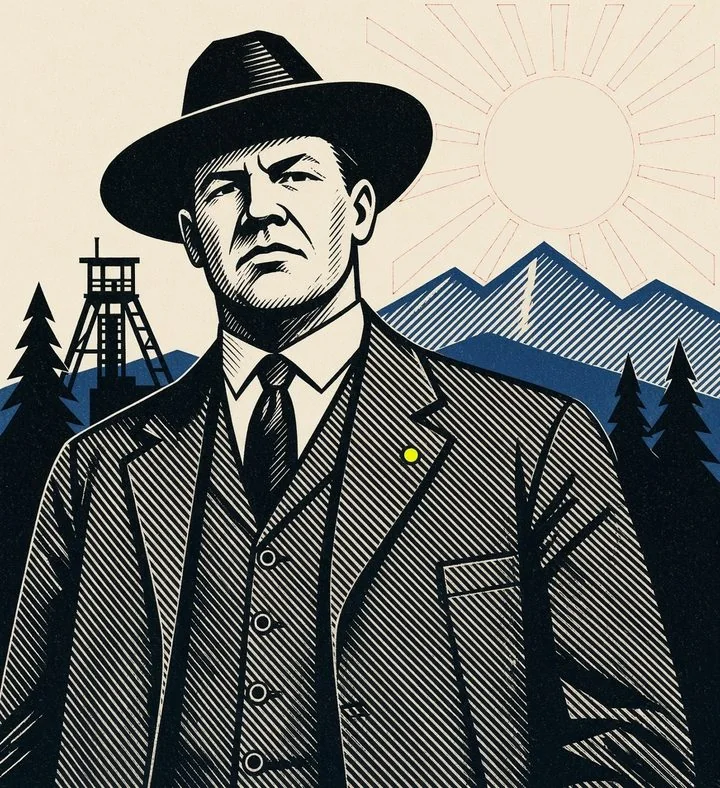


The third part is the one the labor histories skip. Once martial law had broken the Catholic unions, what grew back in their place did not stay Catholic. The Western Federation of Miners was founded in Butte in May 1893 as a direct answer to the bullpen, and within a decade it had been captured by Marxist Revolutionaries. Edward Boyce, the Wardner secretary who had done six months in the Ada County jail, was its president from 1896 to 1902, and the bullpen had radicalized him. In 1897 he told the locals to form rifle clubs. In 1898 he pulled the Federation out of the American Federation of Labor. In 1901 he carried the vote that declared it for socialism, and with that vote he left behind the Faith of the men he had led in 1892.4 He could not plead ignorance. Ten years earlier, in Rerum Novarum, Leo XIII had defended the living wage and the workingman's right to organize, and in the same letter he had condemned socialism outright as a remedy that would hurt the worker first.5 What the miners demanded in 1892 was the Pope's program, and what the Federation adopted in 1901 was the thing he had warned them against. Boyce quit the next year and ended his days as a hotel owner in Portland, and he left the Federation to harder men.
In 1905 the Federation's leaders founded the Industrial Workers of the World, with an Idaho silver miner named Big Bill Haywood in the chair. That December, former Governor Frank Steunenberg, the man who had sent the troops into the Coeur d'Alenes in 1899, was blown up at his own gate in Caldwell. Harry Orchard, the man who confessed to the bombing, named Haywood, and the Pinkerton who took the confession was James McParland, the same man, thirty years older. Haywood walked free from his trial in Boise in 1907, but he was later convicted of violating the Espionage Act. He skipped bail in 1921 and left the country, fleeing to Bolshevik Russia, where he went on to die in Moscow. Half of his ashes are embedded in the Kremlin wall.6
The Catholic miners of 1892 had wanted a wage and a church and a family. What they got, after the owners and the Pinkertons were done with them, was a choice between The Company and the Bolsheviks. Once the Catholic unions were broken, the best-organized men left in the camps were the socialists, and by 1901 the Federation belonged to the Revolution.
Steunenberg deserves a closer look, because he was no saint, and Idaho will meet his type again. The miners had put him in office. He was elected governor in 1896 as a Democratic-Populist fusion candidate with the unions behind him, the first non-Republican to hold the job, and he was re-elected in 1898.7 In April 1899 a Western Federation crowd dynamited the Bunker Hill and Sullivan concentrator at Wardner. Steunenberg declared martial law and asked President McKinley for federal troops, and this time a thousand men went into the bullpen, which was a hay barn and a row of boxcars behind six feet of barbed wire. Three of them died there. The Mine Owners' Association handed him $25,000 for the prosecutions, and under the permit system that followed, no union man could work in the district at all.8 The miners had elected him, and he sold them out to big business. Six years later the bomb went off at his gate, and the men who set it gave the owners the one thing they had always wanted, which was a union with a murderer's name on it.
Every piece of that pattern is back. We have the label again, and the informant, and the imported labor, and the politician who takes the people's votes and then does the owners' bidding. The people in the middle, who want a wage, a church and a family, are being squeezed from both sides again. They face the same question the miners faced when they came out of the bullpen, which is who will be organized enough to pick up the pieces once the old institutions are broken. Last time it was the Revolution. Chapter I described two choices, and the miners' story shows what the second one cost.
What happened to us.
Most of us lived through the next part of this story ourselves. The Tea Party woke a lot of Idahoans up to Sound Money, fiscal restraint, and the plain fact that a country that will not defend its borders, its language, or its culture will not stay a country. Trump in 2016 showed that the donor class and the consultant class did not own the party. Then came the lockdowns. Businesses were shuttered, people who refused the new dogmas were treated like heretics, and some were harassed by their own state police for trying to stay open. Our own governor ordered one for Idaho. It was the third time a governor of this state had suspended ordinary law by proclamation, after 1892 and 1899. Both of those times the excuse was an emergency, and both times the result was a county where nobody could work, trade or assemble without permission. In 2020 the penalty was a fine instead of a barbed-wire fence, but nobody asked the people that time either. Then we watched the places we had left behind go much further. California, Portland, and Seattle made Idaho's version look mild, and people fled those places in numbers large enough to make Idaho the fastest-growing state in the country.9
Each state's first statewide order, as dated by the source. Wyoming issued none. World Population Review, lockdown by state.
What they were fleeing was anarcho-tyranny, where criminals run the streets while ordinary people get fined for opening a shop. Minneapolis burned. Protesters declared an “autonomous zone” in the middle of Seattle and held it for weeks. Portland was on fire night after night, and San Francisco's sidewalks filled up with needles and human waste. These were Democrat-run cities that had stopped functioning as cities and were surviving on federal money taken from the rest of the country. Anyone with eyes could see it, and a lot of eyes opened.
Sources: East Idaho News on the Census Bureau's 2023 state-to-state flows; Understand Idaho, net migration by year; Census Bureau, 2021 population estimates.
What opened them wider was watching Republicans get elected and then govern like the people they had campaigned against. After that nobody had to argue that there was a uniparty, because you could name the people in it.
Who actually holds power in this state.
Micron is one of the largest private employers in Idaho. In fiscal 2025 alone the federal government approved 499 H-1B visa petitions for the company, 206 of them for new hires, and Boise is the work site named on more of its visa applications than any other.10 In the fall of 2021 it told every one of its U.S. employees to get the Covid vaccine by November 20 or be let go, unless the company granted an exemption. Employees with religious objections said the “accommodation” they were offered was indefinite unpaid leave, and their group prepared 29 complaints to the federal Equal Employment Opportunity Commission.11 The same company has been awarded up to $6.165 billion in federal subsidies.12 St. Luke's, the state's largest hospital system, ran the children's gender clinic described in Chapter X.13
Institutions like these have no loyalty to the communities they sit in, and no real loyalty to the minorities whose causes they borrow. The causes are useful to them because they move public money, and when anyone objects, the answer is always a label: extremist, bigot, Nazi, white supremacist. For years Republican leadership flinched every time it heard one of those words, and the people using them were counting on that.
The left did not check out.
The people who moved here were not all the same. Some checked out the day the moving truck unloaded. Life is better than California, the paycheck clears, the ballot says Republican, and that is enough. There is not much we can do about them. The left, on the other hand, never checked out. Reclaim Idaho, the Democratic Socialists, and the rest of that network were already here, and they were not apathetic. Reclaim Idaho and its allies put ranked-choice voting on the ballot in 2024, and another coalition put abortion on the ballot in 2026. Both measures lost, but each one took a statewide signature drive and a statewide organization to get there, and that organization has not gone anywhere. In February 2025 Teresa Borrenpohl, a former Democratic candidate for the Legislature, was dragged out of a Republican town hall in Coeur d'Alene after she would not stop heckling the speakers. Within days, donors had sent her more than $320,000.14 On that side of politics, the people who make a scene get rewarded for it.
The longer campaign has been cultural, and it is older than the initiatives. Groups like the Wassmuth Center, the Kootenai County Task Force on Human Relations and the Human Rights Education Institute have spent decades attaching the word “extremist” to conservatives. When conservatives won a majority on the board of North Idaho College (NIC) in 2020, the Task Force and three other human-rights groups wrote to the college's accreditor and to the U.S. Justice Department asking for an investigation of the new board.15 In February 2023 the Kootenai County Democrats held a “Hijacking Democracy” symposium at a hotel in Post Falls.16 One of its panels was about North Idaho College. It was moderated by Dr. David Adler, and the panelists included Borrenpohl and Christie Wood, a Coeur d'Alene city councilwoman and former NIC trustee who serves on the Task Force. According to a recording of the session published by the Idaho Tribune, Adler asked where the conservative trustees worked and whether they owned businesses, and he raised the idea of a boycott. Wood answered that trustee Todd Banducci had his own business selling insurance and securities, and someone in the audience called out the name of the firm.17 Less than three months later a former NIC instructor walked into Banducci's office and threw a bucket of water and cleaning chemicals on him. The instructor pleaded guilty and was sentenced to three days in jail, a year of probation and restitution. Nobody has shown that he was at that symposium or ever heard the recording, and in court he blamed his own anger at Banducci. We bring it up because that was the atmosphere in North Idaho when it happened.18
Some of the Revolutionaries were born here. They grew up in Coeur d'Alene, left for Seattle, helped turn it into what it is now, and came home when the fight there was over. Revolutionaries who win one city move on to the next town that still disagrees, the way Robespierre kept going after he had won, and they keep going until they turn on each other or until somebody stops them.
The backlash has started.
Stopping it takes a counter-revolution, and one has already started inside the only vehicle that can carry it. The foreign press has been calling it a Republican civil war since 2021.19 Those of us who sit in the meetings would call it the base taking its own Party back. Since Dorothy Moon became chairman in 2022, the grassroots have stopped asking permission from the old boys' clubs and the billionaire networks. The Party has passed a resolution calling for the abolition of the FBI.20 It has put Defend the Guard into the Platform, so that Idaho troops are not shipped off to endless Middle Eastern wars that do not serve the people of this state.21 It has said that transgender ideology does not belong in our schools.
None of this was supposed to happen, and the years since have not been calm ones in Idaho. A former college instructor attacked a conservative trustee at his desk. In February 2026 a stolen ambulance loaded with gas cans was driven into a Department of Homeland Security office building in Boise.22 Conservatives in North Idaho also remember the Fourth of July in 2024, when the Sandpoint store of Cornel Rasor, who is now a Republican state representative, was destroyed in a fire that was charged as arson. No motive for that fire has ever been established.23
October 7, 2023, opened another door that the donor class wanted kept shut. Americans watched the war in Gaza in real time. They saw women and children shot, churches bombed and Christians spat on, and they started asking why their own government was paying for it. In June 2026 the Idaho Republican Party, with precinct committeemen in the room, rejected a resolution demanding unequivocal support for Israel and another blank check in bombs and aid.24 That vote was the first real proof that Zionist and foreign leverage over this Party can be beaten by an organized base. AIPAC can help buy a congressional seat. Thomas Massie lost his primary in May 2026 after AIPAC and groups aligned with the President spent at least $16 million against him, in the most expensive House primary on record.25 It is a great deal harder to buy 981 precinct races that are each decided by a couple hundred neighbors who know the candidate, although Chapter X shows that the other side will try.
November 2026: the voters said it too.
Five months after that convention the whole country voted, and it said what the delegates in Idaho had said. Democrats took both houses of Congress.26 The AP's survey of voters found that about six in ten thought going to war with Iran had been the wrong decision, and about two-thirds thought the President's policies had made the economy worse.27 In the Fox News poll, three out of four voters called the economy bad, and nearly seven in ten said the economic system favors the wealthy.28
Shares are rounded the way the pollsters reported them. The first two rows are from the Fox News Voter Poll, the last two from the AP Voter Poll as reported by the Associated Press and Outlook.
The Vice President wrote the next morning, “The reason we lost is the war.” In the same post he described what a pollster heard when he asked people who had voted for Trump in 2024 and then left the party what it would take to bring them back. Nearly all of the answers came down to four: “End the war,” “Focus on cost of living/inflation,” “Put America First,” and “Change our relationship to Israel.”29 When the President was asked whether he agreed about the war, he said, “I think it's largely true.”30
The country did not turn left that night. One Republican official called it “a punishment election rather than a political realignment,”31 and the numbers bear him out. In one Election Day poll, about a third of the people who voted for Trump in 2024 had stayed home, and fewer than one in ten had voted for a Democrat.32 Even among the people who did vote for Democratic candidates, about one in five told the AP they had a negative view of the Democratic Party.
Those voters were promised no new wars, lower prices, and a government that would put Americans first for a change. By the fall of 2026 they had a new war fought alongside a foreign country, and gasoline and groceries that cost more than before. They had voted for economic populism and American nationalism, and when the Republican Party did not deliver, they punished the Republican Party for it.
What the people want.
What the people want is not complicated, and the miners of 1892 would have recognized most of it. They want wages that can support a family and a house they can afford to buy. They want prices to stop climbing, and money that holds its value. They want immigration law enforced, starting with the companies that hire illegal labor and bring in visa workers to hold wages down. They want their sons kept out of wars that are fought for other countries. And they want the people they elect to do what they promised.
The names for that are economic populism and American nationalism, and Trump won on them twice. Idaho's own delegates voted for them in June of 2026. In November the country punished the party that had promised those things and then walked away from them.
In Idaho the Republican label held, but it is wearing thin. Brad Little's margin over the Democrat fell from 40 points to about 25, Democrats gained six seats in the Legislature, and Congressman Mike Simpson was re-elected in the Second District with less than 52% of the vote.33 If the Party keeps running on the label and governing for the donors, it will keep losing ground here the same as everywhere else. If it delivers what its own voters keep asking for, it has nothing to fear from a blue wave.
The road ahead has been mapped.
Hilaire Belloc and Cecil Chesterton took the two-party racket apart back in 1911, in a book called The Party System. They showed that the leaders of two parties who claimed to be enemies were really one governing class, trading offices back and forth while the voters watched the show.34 And in 1793 the peasants of the Vendée, in the west of France, rose against the Revolution when it came for their priests and their sons, and for a time they beat back the strongest army of their age. We are not called to take up arms, and Chapter I explains why. What we do have to model ourselves after is their refusal to treat their Faith, their homes and their families as negotiable. We trust in Jesus Christ and we also organize, because the line attributed to St. Ignatius still governs the work: act as if everything depended on you, and trust as if everything depended on God.
The Republican Party is the only vehicle we have, and it is steered from 981 precinct seats. The people in those seats decide who leads the Party, who writes the Platform, which candidates the Party vouches for, and whether the resolutions that match how Idahoans actually live ever come to a vote. Knocking doors, volunteering and running for precinct committeeman are how a people that has been labeled, displaced and talked over takes the microphone back.
- William J. Gaboury, Dissension in the Rockies: A History of Idaho Populism (1988), on silver, the Populists and the mining counties. ↑
- “Molly Maguires,” Wikipedia; see also Kevin Kenny, Making Sense of the Molly Maguires (Oxford, 1998). ↑
- “Haymarket affair,” Wikipedia. ↑
- “Ed Boyce,” Wikipedia: WFM president 1896–1902; the 1897 call for rifle clubs; the 1898 break with the AFL; socialism adopted as WFM policy in 1901 at his urging; retired to Portland, where he ran the Portland Hotel Company. ↑
- Leo XIII, Rerum Novarum, May 15, 1891: paragraphs 4–15 reject socialism and the community of goods; 45 on the wage sufficient to support a frugal and well-behaved worker; 49–57 on workingmen’s associations. ↑
- “Western Federation of Miners,” Wikipedia; “Bill Haywood” and “Frank Steunenberg,” Wikipedia, on the 1905 assassination, the 1907 Boise acquittal, the 1918 Chicago Espionage Act conviction before Judge Landis (20 years), the March 1921 bail jump to Soviet Russia and Haywood’s 1928 death and burial in Moscow. ↑
- “Frank Steunenberg,” Wikipedia: elected 1896 as a Democratic-Populist fusion candidate with labor union support; re-elected 1898; his 1899 call for federal troops “was seen as a betrayal by Steunenberg’s union supporters”. ↑
- “Coeur d’Alene, Idaho labor confrontation of 1899,” Wikipedia: the April 29, 1899 dynamiting; federal troops of the 24th Infantry in May; roughly 1,000 men held, three deaths, last prisoners released December 1899; the $25,000 from the Mine Owners’ Association; the permit system. ↑
- U.S. Census Bureau, Vintage 2021 population estimates: Idaho the fastest-growing state, July 2020 to July 2021. ↑
- MyVisaJobs, Micron Technology, from USCIS and Department of Labor records: 499 H-1B petitions approved in fiscal 2025, 206 of them for new employment; Boise is named as the work site on more labor condition applications than any other city. ↑
- Idaho Business Review, “Religious objectors to file civil rights complaints against Micron,” March 4, 2022. Micron said it accommodated everyone who sought a religious accommodation through its process. ↑
- U.S. Department of Commerce, CHIPS incentives awarded to Micron for Idaho and New York, December 2024: up to $6.165 billion. ↑
- Idaho Dispatch, “Hospital in Boise Offers ‘Gender Reassignment’ Surgery,” September 7, 2022. ↑
- East Idaho News, “GoFundMe for woman dragged out of Idaho GOP meeting reaches over $320k,” February 2025. ↑
- Kootenai County Task Force on Human Relations and the Spokane, Bonner and Boundary county human rights task forces, letter of complaint to the Northwest Commission on Colleges and Universities and the U.S. Department of Justice, March 2021. ↑
- Coeur d’Alene Press, “Hijacking Democracy Symposium set for Feb. 25 in Post Falls,” February 8, 2023. ↑
- Idaho Tribune, “Secrets Revealed: Kootenai Dems Plot ‘Hardcore Measures’ Against NIC Trustees,” February 27, 2023. ↑
- Idaho Education News, “Former NIC instructor charged with battery involving trustee,” May 17, 2023; Idaho Tribune, on the sentencing. ↑
- The Guardian, June 7, 2021, on the split among Idaho Republicans over mask mandates. ↑
- Idaho Republican State Central Committee, Summer 2023 adopted resolutions, Challis, June 24, 2023. ↑
- 2026–28 Idaho Republican Party Platform, Article XVII, Section 4 (Idaho Army and Air National Guard): no combat deployment abroad without a congressional declaration of war. ↑
- Fox News, “Stolen ambulance allegedly driven into Idaho DHS office building in attempted arson attack,” February 2026. ↑
- Bonner County Daily Bee, “Woman charged in Army Surplus fire,” July 17, 2024: Rep. Cornel Rasor’s store, destroyed July 4, 2024; first-degree arson charged. ↑
- Idaho Republican Party, 2026 Convention Resolutions as adopted; Resolution 2026-11 was struck on the floor and does not appear. ↑
- NPR, “Kentucky Republican Rep. Thomas Massie loses primary race,” May 19, 2026; The New Arab, May 21, 2026, on the spending. ↑
- Yahoo News, from Associated Press race calls, updated November 15, 2026: Democrats flipped 45 Republican House seats and will hold at least 55 Senate seats. ↑
- AP Voter Poll, November 2026, as reported by the Associated Press and Outlook. The AP also found that about two in ten of the people who voted for Democratic candidates held a negative view of the Democratic Party. ↑
- Fox News Voter Poll, “2026 midterm elections usher in a blue wave as Democrats win control of Congress,” November 2026. ↑
- JD Vance on X, November 4, 2026, as quoted in The Post Millennial and 2paragraphs. ↑
- Arab News, “Trump says ‘largely true’ Iran war caused midterms loss after Vance comments,” November 2026. ↑
- Nathan Layne, Reuters, “Battle for young male voters intensifies after US midterm rebuke of Republicans,” November 16, 2026. ↑
- Newsweek, on a J.L. Partners poll of 1,000 registered voters taken on Election Day 2026: of Trump’s 2024 voters, 52% voted Republican, 35% did not vote and 8% voted Democratic. ↑
- Boise State Public Radio, Idaho November 2026 midterm election results; Sean Coletti, “Idaho’s 2026 Midterms: What the Results Tell Us,” November 13, 2026. Unofficial until the state canvass. ↑
- Hilaire Belloc and Cecil Chesterton, The Party System (London, 1911). ↑